Friday, September 28, 2007

ACFW Conference Pictures

I don't have tons of pictures from the conference like some, but I had enough sense (usually) to capture some of the highlights from the conference.

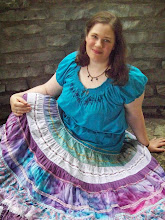
One of the biggest deals for me this year was Saturday night's banquet. For this, we are required to dress up and many woman take the opportunity to wear fancy formal gowns (a trend, I believe, begun by Brandilyn Collins). I've never had a really nice gown like that since my sister's wedding when I was in fourth grade, so this year I thought it high time for one. I designed the dress and my mother volunteered to make it. The result? Judge for yourself:


The banquet was also exciting because many awards are handed out both for the published and unpublished novelist. My friend Sharon Hinck was up for the Book of the Year award (published writers) with her book The Secret Life of Becky Miller. To my delight, she placed second in her category (mom/hen/lady/chick lit). So how could I not mark that great occasion with a picture?


Of course overall I had a great time seeing mentors and friends:

(Left: Me and Brandilyn Collins at Banquet. Right: Shannon McNear and me on last day of conference)

Wednesday, September 26, 2007

Back from Conference...Sort of

After weeks of cramming and preparing, it's all over. The meetings. The classes. The appointments. The American Christian Fiction Writers (ACFW) conference in Dallas has come to a close, and this is where I should be inserting witty comments and deep thoughts about the experience.

However, I stopped to visit relatives on the trek home, and so I've not had time yet to process everything. The ACFW conference remains one long blur of emotions and impressions. Highs where I felt like I could pluck the world from the sky and stick it into my pocket. Lows where I wanted to join the dust mites in the carpet. In between places of zombie exhaustion and childlike wonder.

Of course that doesn't tell much. So I invite you check back during the next couple days--and on the coming Wednesdays--as I try to string together these scattered beads of conference experiences.

Monday, September 24, 2007

Excellent and Praiseworthy

“Finally, brothers, whatever is true, whatever is noble, whatever is right, whatever is pure, whatever is lovely, whatever is admirable—if anything is excellent or praiseworthy—think about such things.” Philippians 4:8 NIV

After weeks of study, Philippians 4:8 is finally complete. We’ve learned about the context of the verse, the recipient, the action to be taken, and six standards. Now today we’ve reached our last words—if anything is excellent or praiseworthy—and within these five words we sum up the six previous qualities listed.

Of course, that’s easy to say. But what does it mean?

Excellence refers to anything that sets its craft over and above others for its good quality. Quality reporting is accurate (true). Quality music is pleasing to the ear (lovely). Quality water is pure.

Likewise the praiseworthy causes praise to one who is worthy—that is, God. So when we treat serious topics in a respectful manner (noble), we bring praise to God. When we declare the truth of Scripture (right), we bring praise to God. When we gain a good reputation (admirable), we bring praise to God.

See how each of the previous standards—true, noble, right, pure, lovely, admirable—expand on these two final qualities?

So in short, we’ve returned to where we began this whole study: the material we read, the material we watch, the material we absorb into our lives should be good in craft/art (excellent) and content (praiseworthy).

Tuesday, September 18, 2007

CSFF Tour: Mars Hill Classified, Part 3

Title: The Return

Series: Mars Hill Classified #3

Author: Austin Boyd

Genre: Adult near-future science-fiction

Excerpt from Chapter 1 of The Return:

Friday, February 21, 2020: Mars

The small point of light moved toward them, an unhurried but relentless advance across a lifeless red plan. Not an out-of-the-ordinary sight on Earth, perhaps—a slow vehicle crossing the high desert. But this was Mars. And until moments ago, eight Martian astronauts, along with all of mankind, had thought those explorers were the sole living beings on this forsaken, desiccated planet.

“The glint’s still headed straight for us.” Rear Admiral John Wells, known to his crew as “Hawk,” pointed at the computer display, consternation knitting his brow. “At the current speed of advance, it’ll be here in three days. Tops.”

John heard the quickened breathing of the seven other astronauts gathered around him in the quiet of the Martian morning. Hemmed inside their tight cylindrical home, the crew formed a tense circle in the mission operations center of their laboratory module.

“You’ve only seen those reflections at sunrise, right?” Martin Oswald, their lanky flight engineer, better know as “Oz,” winced as he plucked hair from the side of his head. The guy’s nerves had gotten so bad the bald spot was hard to miss now.

Colonel Melanie Knox nodded and looked up from a data terminal, her small frame bristling with energy. “Satellite surveillance picks up a glint as it crosses the horizon every morning. But only at low sun angles. There’s no mistake—something’s out there. I woke you because I wanted you to see for yourselves.” She studied her wide-eyed crewmates and waved a hand across the screen. “Whatever it is, guys, it’s closing in on us.”

A grieving astronaut returns to Mars to resolve the past.

The Writing: The writing of The Return has the same strong pulse as the first two books of the Mars Hill Classified. Fast, intricate plotting is made even more intense by a ticking clock. Characters you care about—and a few you don’t—gain more depth and complexity. There are minimal viewpoint problems, like in the excerpt above, but most are scarcely noticeable.

Of most interest to me, though, is how the story ends. This can be one of the hardest things to pull off well in writing: The Return must wrap up not only this book, but also the whole series.

In short, the execution of the end in The Return is not flawless. A handful of expectations planted in earlier books aren’t fulfilled. I also longed to have seen the emotion fleshed out when John learns some shocking news (found on page 437—I won’t say what, since it’ll spoil part of The Proof). To drop that kind of bombshell and to not work it through with John has left the issue feeling unresolved, even though I had suspected the truth early on.

My biggest complaint is the lack of explanation for what happened to Amy and her kids. I understand the spiritual point being made with the parallel to Joseph, but I long for even a basic supposition of the antagonist’s motive—after all, Joseph's brothers had a very real motive, even if God was controlling what was happening. Hence, this plot twist feels forced, as if it was added simply to make that spiritual point and to guarantee point-of-view characters at certain places.

Despite these faults, Mr. Boyd does an excellent job ending this trilogy overall. Loose ends are tied up. Mysteries are revealed. Characters reach a point of emotional closure, satisfying the reader as well. The news article added in the extras at the end also was a nice clarifying tie-up.

The Story: As in The Evidence and The Proof, the spiritual thread is woven almost flawlessly throughout the story. It does get a little heavy-handed and perhaps reiterates the theme a tad too much in the end—largely due to the lack of a motive for what happened to Amy—but as whole, the spiritual dimension is seamless with the rest of the story.

Summary: This is an excellent wrap-up to an excellent series. A must read for science-fiction lovers and the readers of suspense and thrillers, especially techno-thrillers. Because of some of the issues about genetics, pornography, and reproduction dealt with in this book, while not extremely graphic (probably less bloodshed in this book than in the previous two), I recommend that it not be read by those under 15.

Rating: 4.5 out of 5

Can't wait to find out what happens? Order The Return here.

(Click here to see reviews of Book 1 and Book 2.)

Monday, September 17, 2007

Starring Austin Boyd!

Welcome to the September Christian science-fiction and fantasy tour.

This month it is my delight to showcase Austin Boyd and the final book in his Mars Hill Classified trilogy, The Return. With a background as a Navy pilot, spacecraft engineer, and a NASA Astronaut Finalist (among other things), Austin Boyd brings to life the worlds of astronauts, terrorism, and aliens together in sharp detail in his books.

Later this week, I’ll be posting my review of The Return, the conclusion of this complex series. But in the meantime I encourage you to check out my standards for reviews and my analysis of the first two books, The Evidence and The Proof. Then hop on over to Mr. Boyd’s website or one of the other CSFF blogger’s sites to find out what they’re saying about this series:

Trish Anderson, Brandon Barr, Jim Black, Justin Boyer, Grace Bridges, Amy Browning, Jackie Castle, Valerie Comer, Karri Compton, Lisa Cromwell, CSFF Blog Tour, Gene Curtis, D. G. D. Davidson, Janey DeMeo, Merrie Destefano or Alien Dream, Jeff Draper, April Erwin, Beth Goddard, Marcus Goodyear, Jill Hart, Katie Hart, Sherrie Hibbs, Christopher Hopper, Becca Johnson, Jason Joyner, Kait, Karen, Dawn King, Tina Kulesa, Rachel Marks, Karen McSpadden, Rebecca LuElla Miller, Eve Nielsen, John W. Otte, Lyn Perry, Deena Peterson, Rachelle, Cheryl Russel, Chawna Schroeder, Mirtika Schultz, James Somers, Steve Trower, Speculative Faith, Laura Williams, and Timothy Wise

Friday, September 14, 2007

Mars Hill Classified, Part 2

Title: The Proof

Series: Mars Hill Classified #2

Author: Austin Boyd

Genre: Adult Near-future Science-fiction

Excerpt from Chapter 1 of The Proof:

Monday, July 30, 2012: Cape Canaveral, Florida

Simon flinched as the roar and snap of igniting solid rocket boosters boomed across Cape Canaveral. Alone behind a line of tall bleachers, the nine-year-old glanced at the Space Shuttle as it soared skyward, momentarily diverted from the mysterious wave of swaying reeds in a nearby marsh.

“T plus thirty, passing ten thousand feet,” a voice boomed from big speakers in front of the people in the bleachers: his mother, uncle, and hundreds of strangers—important people, he’d been told. Simon watched for a moment, then jogged on toward the fascinating swamp.

Something large was moving in the marsh. As he ran closer, he could see a line of tall cattail stalks waving, probably pushed aside by some giant water creature swimming past.
Alligators! Simon dashed to the water’s edge, pulled off his shoes and socks, and stepped without hesitation into the black water. Sinking knee deep into muck, he crept between sharp blades of saw grass into the bog.

An astronaut flies to Mars to investigate the evidence of alien spiders.

The Writing: What shall I say? The Proof is even better than The Evidence. With the complex foundation now laid, the tension picks up where we left off in book one and never looks back. While some information from book one is reiterated near the beginning, Mr. Boyd does it so well that I barely notice it, even though I read the books back to back. I imagine it would be near invisible to someone who reads the books months apart.

The characters continue to be quite likeable, and flashes of humor endear them further. (Come on—who can’t appreciate the humor of golfing by Venus?)

In the style of The Evidence, the points of view remain a bit fragmented. But now the reader is acquainted with most of the characters and a rhythm has been established, making the shifts easier to track.

Overall, The Proof is near-impossible for me to pick apart at this stage of my writing training. And while I’m sure there are some flaws, this story works. In the end, that is all that really matters.

The Story: The spiritual thread weaves in and out of the story, just as before. Always there, but never intrusive. The character growth progresses at a steady rate and in a logical manner. There is even a conversion scene in the midst of everything, and for once I didn’t mind at all! The scene fits seamlessly and logically in the fabric of the story, just as it should.

My single problem with The Proof is that a couple of the graphic scenes are a bit over the top for me. However, those scenes are integral to the story, so I can’t think of any way to tone them down or to avoid it. It also helps these scenes are few and fairly far apart.

Summary: The Proof is another excellent read, even better than the first! The series remains more guy-oriented and great for those who favor suspense or thrillers. Highly recommended for readers fifteen years and up.

Rating: 4.6 out of 5 stars

Can't wait to get your hands on book 2? Order The Proof here.

(Click to see the reviews for Book 1 and Book 3.)

Tuesday, September 11, 2007

“Whatever is Admirable”

“Finally, brother, whatever is true, whatever noble, whatever is right, whatever is pure, whatever is lovely, whatever is admirable…think about such things.” Philippians 4:8, NIV

Benedict Arnold. Mother Teresa. Las Vegas. Paris. Opera. Rap. Wrestling. Figure skating.

These all have one thing in common: they all have a reputation. Simply say their name, and instantly we associate certain characteristics and qualities with them, whether good or bad or somewhere in between. Mention Benedict Arnold, and betrayal comes to mind. And who doesn’t think of romance when Paris is uttered?

This concept of reputation is the root of admirable. A Greek adjective related to the noun “good reputation,” admirable carries the weight of the commendable qualities associated with a good reputation.

So how does this work with fiction?

A good reputation—and works of fiction do have reputations (think Stephen King books)—applies to the two basic arenas: content and craft. Of course, this means a split can occur. A piece can have a good reputation for the craft while having disreputable content and vice versa.

Of course, the ideal combines both. For example, the movies based on the Lord of the Rings have an overall excellent reputation. In content, they are known for solid Christian theology, sacrifice exemplified, and good defeating evil—all admirable qualities. In addition, the quality of their production and their attention to detail has won these movies the place as the measuring stick for fantasy film in many viewers’ minds.

And how can you tell if the qualities are admirable? Before you walk into that theater or buy that book, ask yourself: Would you want those qualities—whether sweet or graphic, horrifying or humorous—attached to your name?

Friday, September 7, 2007

Mars Hill Classified, Part I

Title: The Evidence

Series: Mars Hill Classified #1

Author: Austin Boyd

Genre: Adult Near-future Science-fiction

Excerpt from Chapter 2 of The Evidence:

Thursday, March 10, 2011: Carp, Nevada

A cloud of white dust rose behind a tractor-trailer as it cut across the sagebrush plains of Nevada’s high desert. The truck moved slower than the narrow dirt road demanded but fast enough for the nervous driver, picking his way down the private ranch lane. Ahead, foothills rose from the desert floor and swallowed the road in the distance. The truck and its occupants, anxious for dusk, chased a retreating sun.

The sun began to settle as the driver reached the foothills and eased the rig back into a dry canyon. He climbed out of the cab and checked the road behind him. He was alone.

Five minutes after his arrival, the trailer was disconnected and he was on his way. Behind him, the unmanned refrigeration trailer remained hidden between steep rock walls. By the time he joined the main highway, the last remnants of the sun had disappeared beyond the foothills, shrouding the trailer in darkness.

Five hours later, a light plane approached from the south. Flying low, a twin-engine Beechcraft circled southeast of the canyon. Two passengers maintained surveillance of the canyon mouth with night-vision equipment and telephoto cameras.

“Trailer’s in sight,” said the passenger in the rear seat, dressed in camouflage and armed with a nightscope to pick out the trailer against the backdrop of rock. His face was nondescript in the eerie green glow of the night-vision device.

The pilot nodded and made a quick radio call. “Lima 42 has traffic in sight. Ready for vectors.”

The reply was immediate. “Roger, Lima 42. Stand by, fifteen seconds.”

A quarter of a minute later, the sky northwest of the aircraft erupted in a searing, white-orange flash.

An astronaut and his wife seek to follow God’s will amidst domestic terrorism, a struggling space program, and the evidence of aliens on Mars.

The Writing: What a pleasure to read! The writing of The Evidence is not perfect, but it’s a large cut above what I’ve been reading of late.

The plot is not the gut-wrenching, “I’ve got to find out what happens next now!” type, like was employed in the Dominion Trilogy by Robin Parrish. But its pace is plenty fast, with tension that builds and builds and builds, and what it lacks in speed Mr. Boyd makes up in intricacy.

Somehow all the facts are presented in a straightforward, chronological manner—granting the reader far more information than any one character has—but despite that, everything is so layered that you are left wondering what just happened. You instinctively know all the pieces fit together, but how—ah! That’s the big question.

However, all this complexity means many foundations must be laid to make it work, which contributes to a slower beginning—up to half the book before the plot reaches full-steam. That can be daunting, but it’s well worth the wait. Like the pull up a roller-coaster’s first hill, Mr. Boyd is only ramping up for a steeper drop and more complex twists.

Like the plot, the characters are also quite deep and true to life. You care about the characters, feel their agony, and cheer them on through their challenges. Maybe not the best-friend types that you’ll follow through a bad plot, but I can easily imagine sitting down with John Wells and the other protagonists for a quiet dinner.

The point of view (POV) are a mixed bag. Not straight forward or hopelessly scrambled, The Evidence’s viewpoints mix omniscient narrator with a large core group of POV characters (where you enter their minds). The breaks between these viewpoints are clearly delineated, and there is no head-hopping within a scene, as far as I’m aware of. Nonetheless they can be confusing, especially at first, because of the sheer number of characters to keep straight. This also contributes to the slower opening that I mentioned earlier, and at times creates a choppy reading experience, since at high tension points you can be covering four or five view points during a very short time period.

The details and descriptions are, well, detailed, probably due to the life experience Mr. Boyd brings to this book. Yet those descriptions do not slow the plotting down as a whole, and they provide a very realistic and plausible air to the book. And while I could not begin to grasp everything—being technically challenged—I expect that the mechanical and science-minded will find his details a veritable feast.

The Story: The Christianity of The Evidence rings loud and clear without being preachy, tying directly into the outcome of events. This easily ranks in my top ten examples of how faith and fiction should intersect.

In addition, difficult topics are handled in a respectful—and clean—manner. No direct swearing, no sex scenes (even though sexual temptation is touched on). There is violence—terrorism is one of the main topics—but the descriptions are kept to a minimum and are usually (though not always) done from an omniscient POV, which provides some emotional distance.

Summary: The Evidence isn’t a book for a quick afternoon's read. But if you will settle in for a slightly longer than normal haul, allowing yourself time to absorb the details, your patience will be well-rewarded. Due to some of the topics, I would suggest holding this book back for older teens (15+) and adults. But otherwise it’s well worth the time for any science-fiction or suspense reader, especially guys and the technically minded.

Rating: 4.4 of 5

Can't wait to read The Evidence? Order now.

(Click to see reviews for Book 2 and Book 3.)
Wednesday, September 5, 2007

The Proposal Every Novelist Wants to Write, But Can’t

Being in the midst of conference crush means my life is occupied by one thing: Proposals. Updating old proposals. Creating new proposals. Editing bad proposals. Trashing the proposal I just edited. My life has been completely consumed by those dozen pages in which I’m supposed to sum up the plot, characters, theme, competition, marketing plan, and my qualifications for writing a 300-page book. I even woke up this morning composing a proposal for the dream I just had!

Frustrated with this bane of all writers, I decided throw out every rule I’ve ever heard, skip over all the platitudes intended to pacify an editor, and say what I really mean:

A Novel Proposal by Chawna Schroeder

Title of Novel: Mark of the Vine or The Dueling Sisters or whatever great title I decide to give it on any particular day—and don’t you dare try to change it.

Target Readers: Everyone with enough brains to like my book.

Genre: A little bit of this and a little bit of that.

Length: It’ll have however many words it takes to tell the story.

Completion Time: It gets done when it gets done.

Tagline: A girl does something, her antagonistic sister makes it worse, and the girl gets into serious trouble.

Summary: Cora has a quiet life, but she wants more. Her obnoxious sister gets her into trouble so that she has to do the unthinkable. That gets Cora into deeper and deeper trouble until she is faced with an impossible decision.

Spiritual Takeaway: Something about reaping what you sow. Or the need to take responsibility for your actions. Or maybe both.

Market Comparison: My book is one-of-a-kind; there is nothing else out there quite like it. Why else would I have written it? So here’s my story. Take it or leave it. And you had better take it.

Marketing Plan: I like my book. I want it to sell well. I’ll brainstorm some ideas to promote it—which won’t take much because everyone will love it—when you decide to buy it.

About the Author: I am a writer. I like to write and I have studied writing many years. Don’t have much else to say. This is who I am. If you don’t like it, take it up with God. He created me.

Synopsis:

Cora and her sister fight. Cora gets into trouble and runs.

She enters a competition in disguise. Many bad things happen. Clerical errors. Lost luggage. A saboteur.

Cora makes it the final round. So does her sister. Her sister threatens to tattle. Cora withdraws. Then she doesn’t. And she wins and gets everything including the boy. Her sister goes away mad with nothing.

Character Synopses:

Cora is the good guy.
Johari is the bad-guy sister.
Brauni is a saboteur.
Philip is the boy Cora likes.
Ellie, Trex, and Mai are her friends.
Counselor Levine doesn’t know what to think.


Writing a proposal is so much simpler this way. It’s concise and says everything I want it to say. Too bad an editor won’t agree. So I guess it’s back to the drawing board for me.

Monday, September 3, 2007

“Whatever is Lovely” Part II

"Finally, brothers, whatever is true, whatever is noble, whatever is right, whatever is pure, whatever is lovely…think about such things.” Philippians 4:8 NIV

Last week we covered the qualities of “lovely.” While loveliness is partially in the eye of the beholder, we discover that there is an innate sense of beauty that God built into each of us, an ability to recognize what pleases the senses and spurs us toward love. But how does this affect the fiction we read and the movies we watch?

Perhaps the most obvious application is to film. Since we tend to think of loveliness first in the visual realms, it’s easy to see how we might expect a movie to be lovely—after all, movies are continuous strings of images which can please the eye. But books too strive to create pictures in the mind’s eye, and like a shot in a film, we can find those pictures pleasing or displeasing.

Loveliness, however, is not confined to the visible realm, as the previous example with books hints at. Part of what makes the image from the written word pleasing is the use of the language. Consider how “a quaint cottage with spring flowers sprouting everywhere” paints a more beautiful image than “a dilapidated house overrun with weeds” does, even though they may describe the same scene.

More than that, the combination of words can please the ear the way a picture please the eye. Look again at the descriptions above and notice how alliteration of the first (a quaint cottage with spring flowers sprouting everywhere) pleases the ear more than straightforward language of the second. But by simply changing a few words, that second description can also become more pleasing to the ear without eliminating the unpleasant image: “A dilapidated dwelling overshadowed by weeds.”

This auditory pleasure is one foundation of good writing. On it we build everything from vivid descriptions in books to patter songs in musicals to dialogue in fiction and film. It also comprises a large part of the art of poetry and is a primary reason why Shakespeare is classic today.

But loveliness is more than sensory pleasure. Loveliness should cause love, the kind that God intended. For like everything else, sin can twist words and images to induce sensuous, idolatrous, or erotic love. Instead, lovely stories seek to evoke the love of I Corinthians 13:

“Love is patient, love is kind. It does not envy, it does not boast, it is not proud. It is not rude, it is not self-seeking, it is not easily angered, it keeps no record of wrongs. Love does not delight in evil but rejoices with the truth. It always protects, always trusts, always hopes, always perseveres. Love never fails.” (I Corinthians 13:4-8a, NIV)

Now those are the marks of a truly beautiful story.